

Behaviour principles
Autistic people are affected in a variety of ways and to very different degrees. This is why it’s called ‘the autistic spectrum’. Autism can affect children with any level of intellectual ability, from those who are profoundly learning disabled to those with average or high intelligence. So, having autism doesn’t mean that your child has learning difficulties.
The more seriously affected children at one end of the spectrum have learning difficulties as well and require high levels of support. At the other end of the spectrum, some people with ‘high-functioning autism’ are very intelligent academically. They may go on to be successful in their chosen field. However, they may still experience significant social and communication differences.
"It's as if your child's brain has been wired up in a different way than usual. This doesn't change, but the ways in which it shows itself, and the extent to which it shows itself, do change." Early Support
"It's nothing that you've done. A child doesn't become autistic. It's in them already. They don't learn to be autistic." Early Support
When to ignore a behaviour
Ignore the individual when they interrupt you talking by asking for something, but respond immediately if they say ‘excuse me’. In this situation the individual will learn that they will only get the response they are seeking by saying ‘excuse me’ first.
In order to help the learning of new behaviours it is important that your response is clear and consistent, you must respond in the same way each time.
When to reward a behaviour
Sometimes, the ‘reward’ for a behaviour is the attention you give to it. We can give attention to a behaviour in a number of ways including praising, giving rewards such as stickers or money, shouting, asking for explanations etc. Sometimes we do not even realise we are rewarding a behaviour because we are shouting or being negative to try and stop it. However, for a child, shouting or being negative still counts as attention and they may prefer that to being ignored. This may reinforce the behaviour rather than stopping it.
In an autistic individual the picture can be even more confusing, for example if the individual prefers to spend time alone, using ‘time out’ as a punishment could be rewarding. It is therefore important that you take the individual into consideration when deciding on how to give or remove rewards for a behaviour. When managing an autistic individual’s behaviour, it is important that you adapt your communication and this was discussed in an earlier section.
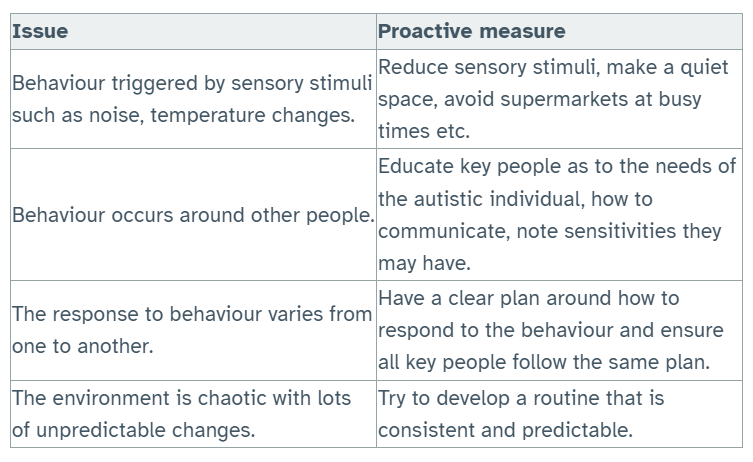
Making changes to a child’s environment can avoid many triggers for meltdowns; rather than trying to change the behaviour it can be more helpful to change the environment. For example, if sensory issues are the cause of the unwanted behaviour.
The table below shows some possible environmental triggers and some changes you could consider.
Top tips for supporting your child with different behaviour
- Be positive and praise good behaviour. Make sure praise is given immediately following the wanted behaviour. Use specific praise, clearly naming the wanted behaviour so that your child knows what you are praising them for.
- Don’t try to change too much too soon. Tackle 1 or 2 things at a time and perhaps try to choose something which will be easier to change first.
- Improve the way you communicate with your child. Read more about communication.
- Help your child to understand and change their behaviours through, for example, social stories (see ‘Resources’ section at the end of this Guide) and explaining about other people’s thoughts and feelings.
- Use calendars, sand timers and other visual information to help your child understand what’s happening when.
- Plan ahead for activities and changes to routines (see section on managing change). Find out what relaxes your child so that you can help them calm down.
The most valuable piece of advice I have gathered is to have patience and to try to see things from their point of view.

Making sure my son is not hungry stopped his challenging behaviour. It took a friend to notice and point it out to me. That was a few years ago. I did not feel bad; I just did not know. Regular meals solved the problem.


