
Phonological awareness activities
Rhyme awareness
This means noticing when words sound the same at the end. For example, cap and map, or kite and flight. Remember, it is about listening to the sounds, not looking at how the words are spelt.
Activities to try
- Sing nursery rhymes, such as, Hickory Dickory Dock, Jack and Jill, Twinkle Twinkle or A Sailor Went To Sea. Pause before the next rhyming word in order for the child to add it in.
- Read books with rhyming patterns, such as, Each Peach Pear Plum, Aliens Love Underpants, The Gruffalo or There’s A Mouse In My House. Pause before the next rhyming word in order for the child to add it in.
- Make a rhyming bag or box. Collect a few objects that rhyme, starting with around 4 objects (2 pairs) and take it in turns to take out and name the object. Once they are all out, encourage the child to match their object to its rhyming pair. It is important to use objects or pictures of things the child would easily recognise. In time, increase the amount of objects or pictures to put in the bag or box.
- Play odd one out. Use pictures or objects where 1 item does not rhyme but the others do. Ask the child to select the odd one out. For example, you could choose:
Onset and rime
This is when we break down 1 syllable. The onset is the first sound, and the rime is everything that comes after. For example, in 'cat', the onset is 'c' and the rime is 'at'. If there is more than 1 sound at the start, that is still the onset. For example, in 'tree', the onset is 'tr' and the rime is 'ee'.
Activities to try
- Silly Sally: Change the first sound of a word to a different letter. For example, in Silly Sally, you blend 's' to the rime of each word. So 'cup' becomes 'sup'. Some words will make sense like me - see, and bike - sike. Some will be nonsense, like mouse - souse. You can play with other letters too, like Silly Billy (change to b) or Silly Curly (change to c).
- Onset–rime slide: Use a toy or picture of a slide. Show the child how to start at the top of the slide with the initial sound 'c' and say the rime as they go down the slide, 'at'.
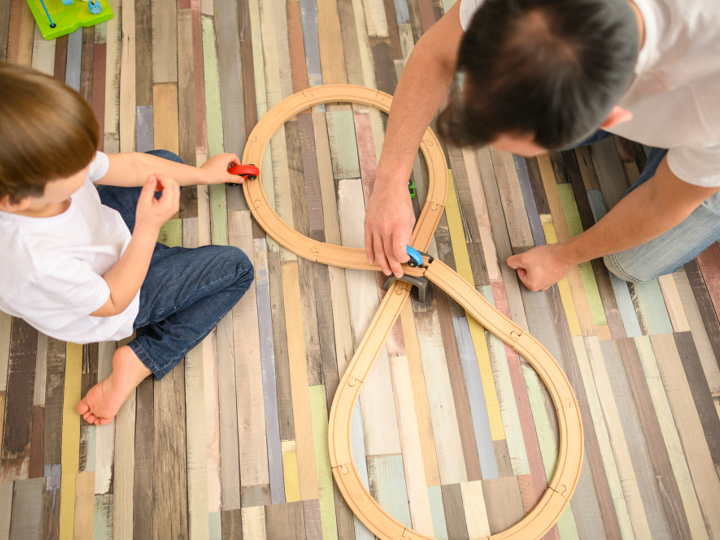
- Round the race track: Use a toy car track. Say the onset before you move the car, then the rime as the car moves.
- 1 – 2 punch: Say the onset while punching your left arm forward. Say the rime while punching the right arm forward, keeping the left arm where it is. Then push both arms together to say the whole word.
- Bean bag toss: Choose a picture or object. Throw one bean bag for the onset and another for the rime, then say the whole word.
Blending and segmenting
Blending is when you put sounds together to make a word. For example, 'b–u–s' makes 'bus' and 'cr–a–b' makes 'crab'.
Segmenting is when you split a word into its sounds. For example, 'dog' can be broken down into 'd–o–g'.
It’s important to listen for the sounds, not just look at the letters or spelling of the word. For example, mouse has 5 letters but only 3 sounds 'm–ou–se'.
Activities to try:
- Modelling: Show children how to blend sounds in real life. For example, “It’s time to get your b–a–g… bag!” or “Touch your t–oe–s… toes!” When reading rhyming books, blend the last word together, for example, “I like the sun, outside we have f–u–n… fun!”
- Object choice: Lay out pictures or objects. Using a puppet or toy, ask: “Where is the sh–ee–p? Where is the b–a–g? Where is the f-i-s-h?”
- Cross the bridge: Make 2 lines on the floor with tape or chalk, and ask the child to stand behind 1 of the lines. The aim if for the child to get from one line to the next line. Give the child a picture or object, such as a leaf, sheep, soap, fish, sock or bus. Say: “Take one step forward if you have a p–i–g.” Keep going until there’s a winner.
- Robot talk: Talk like a robot so the child can hear segmented sounds. Then, blend them back together into words.
- Blending song: Using the tune of "If you’re happy and you know it, clap your hands", sing:
If you think you know this word, shout it out!
If you think you know this word, shout it out!
If you think you know this word,
Then tell me what you’ve heard,
If you think you know this word, shout it out!
After singing, say a word in sounds like 's–u–n' and see if the child can work out the word.
Phonological awareness top tips
- Make it fun: The activities and suggestions are to help the child enjoy the learning process. Most activities can be done in lots of different environments, not just at a table.
- Keep it short: Regular, short activities will be more effective than longer activities. Aim for 5 to 10 minutes a day.
- Make it visual: Use pictures, objects and props to keep the child engaged. Involve all the senses where possible.