
Input activities
An important step in supporting speech sounds is to give the child lots of opportunities to hear the correct production of sounds. At this stage, the focus is only on the child listening. It's great if they join in or copy you, but do not force them to repeat words or correct any errors.
Be creative and try to incorporate the child’s interests, either in the words you use or the games and activities you play. Be positive and give lots of praise.
Remember, it is important we model the sound and not the letter when working on speech sounds. For example, we must say ‘p’ and not ‘puh’ or ‘pee’.
Auditory bombardment
This means repeating sounds lots of times so the child can hear it being pronounced correctly.
Activity ideas
- Read stories with repetitive sounds: For example, ‘The 3 little pigs’ has lots of 'p' words in it.
- Share tongue twisters: For example, ‘She sells seashells by the seashore.'
- Bingo or matching pairs: Use pictures or items that start with the same sound.
- Sound bag or box: Collect objects starting with the same sound and put them in a bag or box. For example, if you are supporting a child who finds 's' tricky you could include a sock, soap, sack, a toy saw and a picture of a sandwich. As the child pulls them out, you can name them and talk about them, using the target sound lots of times.
- Sound loaded scenes: Find pictures that contain lots of images relating to the same target sound. For example, a ‘f’ loaded scene might have ‘fish’, ‘fox’, ‘fingers’, ‘fireworks’, ‘finding’, ‘four’, ‘farm’ and ‘fairies’.
Output activities
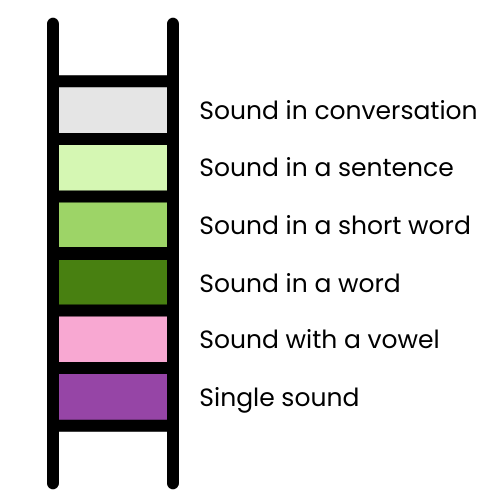
When children learn to use a new sound, they learn in stages. The stages start at the easiest level (bottom of a ladder), and as the child improves you move towards the harder levels (top of the ladder).
The stages you need to work through are very small and it is important to work through them in order. It is also important not to move on from 1 stage to another before the child is ready. Before proceeding to the next stage the child must be achieving 80 to 90% accuracy at the current stage. You may need to spend quite a few weeks on each stage.
You can go back over the earlier stages for extra practice even once you have moved onto the next stage.