Talking boxes
Professionals can use talking boxes to support children’s speech and language development by building strong communication skills through short, fun activities.
Talking boxes are a way to help children develop their speech, language and communication skills.
They are colourful boxes that contain toys and materials focussed around a particular topic or theme. For example, vehicles, animals or clothes. All of these items will be available in your early years setting.
The ideas used in the groups are then extended to support language learning in all other everyday activities.
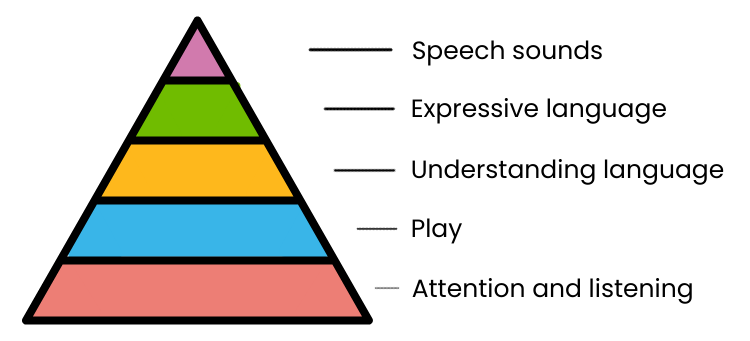
Each talking box contains activities based on the language development pyramid.
Think about building a pyramid. You need to build the bottom first, before you can add the top. Speech and language development works in the same way. Children need strong foundation skills first. These include attention and listening skills and play skills.
If a child does not have these skills, they may find it hard to develop other speech and language skills further up the pyramid.
Because of this, you should always plan to start with the listening activities. This helps you see if the children you are working with have the foundation skills.
Look at the children playing in your setting. Do they know what to do with toys? Are they playing with them in a constructive way? This can tell you a lot about their early development.
Next, think about the understanding activities. A child may be able to talk, but this does not always mean they understand everything that is said to them. This is why it's important to check their understanding.
Talking boxes are for children from 2 years old until the end of pre-school. But all children develop at different rates. Always think about their developmental level.
Talking boxes are suitable for all children, including children:
- who have attention and listening difficulties
- with communication difficulties
- with English as an additional language (EAL)
- who already have age-appropriate communication skills
Talking boxes are a good resource for children with EAL because you use real objects and keep your language simple. Repetition of activities and vocabulary is important for these children.
Talking boxes are also suitable for children who are on a waiting list for speech and language therapy. If you have a copy of the child’s speech and language therapy report, it will usually tell you what they find difficult. For example, poor attention and listening. This can help you choose the right activities. If you are unsure, contact the child’s speech and language therapist.
You can try using the box as an exploratory activity with children under 2 years. Allow them to look at the items in the box while you name them.
Using the talking boxes
Talking boxes work best when they are used regularly. Try to use them 2 to 3 times a week. If you add them to your weekly planning, it is much more likely that they will happen.
You can use talking boxes at any time during the session. Some settings find they work well during free play. But choose a time that suits your routine.
It is best to use talking boxes in a quiet place. This might be a separate room, a quiet corner, or outside.
Talking boxes are suitable for all children. They can be used with 1 child or in a small group.
When choosing groups, think about how children will work together. It can help to have a more talkative and confident child to act as a role model for quieter, less verbal children. Try to make sure that 1 child doesn't take over the group. Sometimes it works better to group confident children together.
The group should be a size that you feel comfortable with, but keep it small so the children don't have to wait too long for their turn.
If you use the activities with a group, it is best to have 2 adults. 1 adult can lead the activities and the other adult can support the children.
Always start with the listening activities at the beginning of the booklet. These help to build strong foundation skills. The listening games, such as “Who’s talking?” are suitable for children around 2 years old. Children will love singing the different songs and listening to simple stories. It’s important to use the items in the box when you’re singing. For example, hold up the cow as you’re singing, “Old MacDonald had a cow”.
When looking at the understanding activities, start with the simplest ones. Move on to the next level when you think the children are understanding these instructions.
The activities can be used as single activities, or one after the other. You do not need to work through a whole booklet in 1 session. It is best to mix and match activities. Plan what you want to do before the session, but always have a back-up plan in case children lose interest.
When you've finished all the activities from 1 box, move on to a different box. Children may have favourite activities and topic boxes, but it is important to use a range of topics and activities. This will help widen their interests.
You can also add your own songs and ideas to the talking boxes.
Each session should last 5 to 10 minutes, depending on the age and interest of the children. At ages 3 to 4, sessions should usually be no longer than 10 minutes. For younger children, sessions will be even shorter.
Always follow the children’s lead. A short, enjoyable session is much better than a long one where children lose interest.
To finish the session you can sing a song or read a short story. Give specific feedback to the children about how they have listened or sat. For example "Good listening" or "Good sitting". Let them know the session has finished and tell them what they're going to do next. For example "Now it's snack time".
If you feel that the group isn't working, take time to reflect on what you are doing.
- Are you going too fast?
- Is the group too big?
- Are children being given enough time to respond?
- Are the group dynamics working?
Talking with a colleague can help you think about what you may need to change.
It is important that children hear good models of language throughout the day. Make sure everyone knows what the theme of the talking box is that week. This will help all the adults to model the vocabulary throughout the day.
For example, if the theme is vehicles you can play ‘ready steady go’ games with a traffic light and bikes outside. You could make sure that there are some fire fighter, police or train driver dress up clothes out that week. You can also leave out vehicle books in the book area. Encourage the whole group to sing some of the vehicle songs later in the day.
Make sure parents know what your talking box theme is for the week. Help them to think of ideas and ways to introduce the vocabulary at home or when they are out and about. For example, saying ‘bus’ every time they see a bus, or singing the ‘wheels on the bus’ song at home.
The more children hear the new words, in lots of different situations, the more likely they are to learn that word and use it themselves.
Talking box themes
Content is loading...
Talking Boxes relate to the Early Years Foundation Stage (September 2008) and the Letters and Sounds guidance (Primary National Strategy).