Food talking box
What you will need
You will need to the following in the talking box:
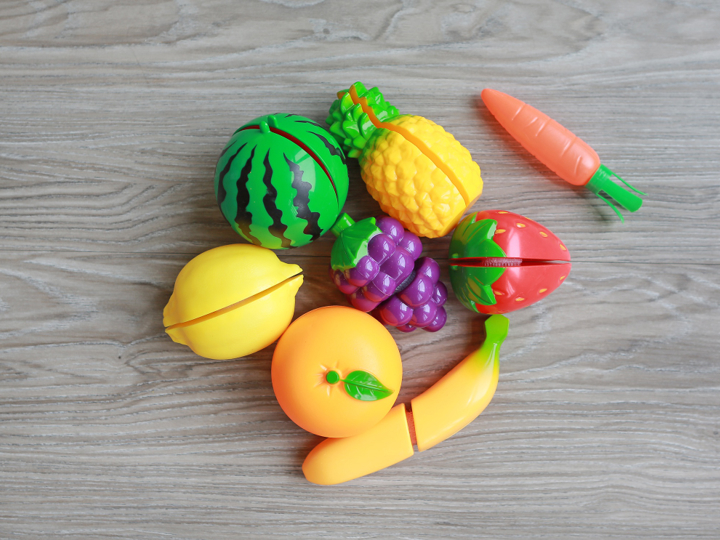
- pretend fruit and vegetables
- any other pretend food in your setting.
You can use real fruit, vegetables or other foods for these activities.
You will also need:
- pictures of apples and bananas
- junk modelling to make 'monster'
- toy plates and cups
- toys to pretend to eat and drink
- 2 baskets or trolleys
Target: attention and listening
You will need pictures of apples and bananas for this activity.
Give each child a picture of either an apple or a banana. Tell them what it is, to make sure they know.
When you say “apple”, all the children holding an apple need to stand up. When you say “banana” all the children holding a banana need to stand up. To make it more fun, the children could jump into a hoop when they hear their fruit’s name being said.
Some children may need you to hold up a picture of the fruit (apple or banana) too, as a visual support.
Target: understanding language
You need to know how much the children in your setting understand. Use these activities to work out how many key words the children understand if you are not sure.
1 key word
You will need the toy food in the box and a monster to feed for this activity.
Before you do this activity encourage the children to look at all of the items in the box. Talk about each 1 of the food items. What is it called? When you’ve looked through all of the food say, “Who is going to eat all this food…Let’s make a monster to eat it all up!"
Find a “monster” in your setting, or make one with the children. You could find a shoe box and decorate it to make it look like a monster and then cut a hole for its mouth. Make sure the hole is big enough to fit the pretend food.
Set the scene: “Monster’s hungry! He wants some food”. Get 1 of the children’s attention, “Jo, monster wants some cake. Give him some cake”. Encourage the child to feed the cake into the monster’s mouth. Give each of the children a turn to feed the monster something that you tell them to.
If the children need extra support you can:
- repeat the instruction again, such as "Monster wants cake"
- encourage the child to find the cake, “Where’s cake?”
- pick up the cake and another food item for the child to select the cake from
2 key words
You will need 2 monsters or puppets and toy food for this activity.
You could make another monster and give them a name or use a puppet. Play the same game as the I'm hungry activity but this time tell the children who to feed. For example, "Give Gordon a banana". The keywords are Gordon and banana.
If they pick up the wrong item of food or feed it to the wrong monster, encourage them to “listen again” and then repeat the instruction.
If they are still unsure then break the banana. When they have found the banana say, “Give it to Gordon”.
If you have them available you will need 2 things you could put the food in. For example, a basket, trolley, bag or box.
Take all of the food out of the box. Make sure the children know what each item of food is before you start.
Choose 2 toys or children to go shopping. Each of them needs to have something different to put food in, such as a basket, trolley, bag or box.
Introduce the concept of “empty”. “Look at their basket. It’s empty! There’s nothing in it. We need to get some shopping”.
Give the children instructions, for example, "Put an apple in the basket". Go round the circle until the children have all had a turn.
3 key words
You will need 2 toys, 2 baskets, 2 plates and toy food for this activity.
Choose 2 toys from your setting. Tell the children they are going on a picnic, “We need to pack all the food we need. Let’s see what’s in our box to take with us to eat”. Open the box and talk with the children about the food. Put it in a bag or basket to take with you. “What else do we need?” Maybe some plates and cups.
Walk over to a different part of your setting. Put a blanket on the floor to sit on. Place the 2 toys with you on the blanket with a basket and plate for each of them. Say “Let’s see what they’re going to eat. Teddy would like to eat an apple." Choose a child to give the instruction to, such as “Alice, put the apple on teddy’s plate”. The key words are apple, teddy's and plate.
Extending the activity
You can use different coloured plates or big/little plates. For example, “Put the apple on Teddy’s big/little plate” or “Put the cake on Dolly’s red/green plate”.
Target: talking (using language)
You will need a monster and toy food for this activity.
Use the monster from the understanding language activity. Fill the monster with the toy food. Encourage the children to guess what’s inside or put their hand inside and see what’s there.
You will need toy food, a tray and a tea-towel for this activity.
Place all the food items on a tray and encourage the children to look and talk about the items. Then, cover the tray with a tea-towel and remove 1 of the items. Don't let the children see you do this. Can the children guess what’s missing? You might need to give them some clues, such as "It’s round". You can show them the shape with your hands.
Extending the activity
Once you know children are familiar with a story, encourage them to retell the story to you. Let the children use the animals in the box to help tell the story.
Taking 1 animal at a time out of the box, encourage children to tell their own story. You could bring in other items from around your setting to link into the story. Or encourage children to go and find something.
Extension activities
This would be a good activity to do before you make cornflake/rice crispie cakes so that the children know what to expect. You could also do it after making cornflake/rice crispie cakes, as a recap of what you have done.
Take photographs of the different stages involved in making cornflake/rice crispie cakes.
Help the children to put the photographs in the right order and talk about what is happening in each picture.
You will need the pretend food in the talking box for this activity.
Place the talking box in the middle of the circle of children.
As the adult leading the group, choose something from the box and say, “We went shopping and we bought…” (and say item you have chosen, like a banana). Continue to hold the item.
Ask the next child to choose something from the box, and then model this sentence for the child to try and copy. For example, “We went shopping and we bought a banana and an apple”. The child continues to hold the item they chose.
Continue around the circle until everyone has had a turn. As you go around the circle each child will need to say the items that have been bought. By the end, the sentence could sound something like, “We went shopping and we bought a banana, an apple, some grapes, a pear and an orange”. Encourage each child to hold up their item in the air as it is said.
Don’t worry if the children can’t say the whole sentence just encourage them to name the items that the other children are holding.
Target: play and imagination
Set up a shop or café. Let the children take turns choosing what they want to buy or eat.
For less verbal children you may need to offer a choice, such as “Would you like cake or bread?”. You can show them the items as you offer the choice.
Target: singing
Remember to sing slowly so the children can hear the words.
Make some pretend currant buns with the children. You could get a real one for them to copy.
Five currant buns in a baker's shop
Round and fat with a cherry on the top
Along came Milo with a penny one day
Bought a currant bun and took it away
Four currant buns in a baker's shop
Round and fat with a cherry on the top
Along came a monkey with a penny one day
Bought a currant bun and took it away
Three currant buns in a baker's shop
Round and fat with a cherry on the top
Along came a tortoise with a penny one day
Bought a currant bun and took it away
Two currant buns in a baker's shop
Round and fat with a cherry on the top
Along came a tiger with a penny one day
Bought a currant bun and took it away
One currant bun in a baker's shop
Round and fat with a cherry on the top
Along came a bee with a penny one day
Bought a currant bun and took it away
You could make some pretend sausages or find some plastic ones.
Five fat sausages sizzling in a pan
Five fat sausages sizzling in a pan
One went pop!
and the other went bang!
There were four fat sausages sizzling in a pan
Four fat sausages sizzling in a pan
Four fat sausages sizzling in a pan
One went pop!
and the other went bang!
There were three fat sausages sizzling in a pan
Three fat sausages sizzling in a pan
Three fat sausages sizzling in a pan
One went pop!
and the other went bang!
There were two fat sausages sizzling in a pan
Two fat sausages sizzling in a pan
Two fat sausages sizzling in a pan
One went pop!
and the other went bang!
There was one fat sausage sizzling in a pan
One fat sausage sizzling in a pan
One fat sausage sizzling in a pan
One went pop!
and the other went bang!
There were no fat sausages sizzling in a pan
No fat sausages sizzling in a pan
No fat sausages sizzling in a pan
None went pop!
and none went bang!
There were no fat sausages sizzling in a pan
Bananas in pyjamas are coming down the stairs,
Bananas in pyjamas are coming down in pairs,
Bananas in pyjamas are chasing teddy bears,
'cos on Tuesdays they all try to catch them unawares!
One potato, two potatoes, three potatoes four
Five potatoes, six potatoes, seven potatoes more
One potato, two potatoes, three potatoes four
Five potatoes, six potatoes, seven potatoes more
Oranges and lemons
Say the bells of St. Clements
I owe you five farthings
Say the bells of St. Martins
When will you pay me?
Say the bells at Old Bailey
When I grow rich
Say the bells at Shoreditch
When will that be?
Say the bells of Stepney
I'm sure I don't know
Says the great bell of Bow
5 little peas in a peapod pressed
(press 2 fists together)
1 grew, 2 grew, so did all the rest
(fingers slowly pop up from fist)
They grew and they grew and did not stop
(slowly move hands apart)
Until one day the pod went pop!
(Bring hands together with a big clap!)
Book recommendations
- Ketchup on your cornflakes? by Nick Sharratt
- The Enormous Turnip by Jan Lewis
- Each Peach Pear Plum by Allan and Janet Ahlberg
- Don’t Forget the Bacon! by Pat Hutchins
- Pass the jam, Jim by Kaye Umansky and Margaret Chamberlain
- The Shopping Basket by John Burningham
- The Very Hungry Caterpillar by Eric Carle
- I will not ever never eat a tomato by Lauren Child (for older children)
- The Tiger who came to Tea by Judith Kerr